
Why Do My Headlights Flicker at Idle but Not at Speed?
NaTasha Brand • March 25, 2026
(And Why Your Mechanic Needs to Be a Detective)
There’s a unique kind of automotive anxiety that sets in when you’re sitting at the intersection of Knickerbocker and Bryant, waiting for the light to turn green, and you notice your headlights are doing their best impression of a disco ball. They pulse. They flicker. They dim.
Yet, the moment you hit the open road, whether you’re cruising down Houston Harte or finally escaping town on Highway 87, they settle down and shine steady. If this sounds familiar, congratulations: your car isn’t haunted. It’s just trying to tell you something, and it’s speaking in the language of voltage.
The Electrical Tightrope Walk
Your car’s electrical system is a delicate balancing act between two key players: the battery (which starts the party) and the alternator (which keeps the party going). When your engine is idling, your alternator is spinning slowly. At low RPMs, it struggles to produce enough amperage to run everything, the fuel injectors, the ECU, the A/C blower, and yes, those hungry headlights.
If everything is working perfectly, a voltage regulator smooths out the power, ensuring a steady stream regardless of engine speed. But when you see that flicker at a stoplight, it usually points to one of three culprits:
- Alternator Output Fluctuating at Low RPM
Alternators have a minimum speed requirement to generate sufficient power. At idle, if the alternator is aging or its internal components are wearing out, it simply isn’t spinning fast enough to meet the electrical demand of the vehicle. The lights dim because they’re essentially running off the battery’s residual voltage for a split second until the alternator catches up. Once you accelerate, the pulley spins faster, output normalizes, and the flicker vanishes. - The Voltage Regulator is Failing
This is the heart of your charging system. The voltage regulator acts like a strict bouncer at a club, telling the alternator exactly how much voltage to send out. When this component starts to fail, it loses its grip. The voltage starts to “hunt” up and down, typically between 12 and 14 volts, causing that rhythmic pulsing in your headlights. At speed, the increased RPM can sometimes mask the regulator’s inability to maintain perfect control, but make no mistake: when this fails entirely, you’re walking home. - The Serpentine Belt is Slipping
Let’s not forget the rubber. The serpentine belt drives the alternator. If the belt is glazed, cracked, or the tensioner is weak, the belt may slip on the pulley at low RPMs. At idle, it’s losing grip, causing the alternator to stop spinning momentarily. When you speed up, centrifugal force and increased tension allow the belt to grab again. This is often accompanied by a squealing noise, nature’s way of saying, “Replace me before I leave you stranded in the H-E-B parking lot.”
Why At-Speed Hides the Problem
It’s simple physics. When you increase engine RPM, the alternator rotor spins faster, generating higher amperage. This surge in power typically overcomes the minor deficiencies in the system. A weak voltage regulator can fake competence at 2,500 RPM. A slipping belt can hold on when the momentum is high. But a car is judged by how it behaves in the mundane moments, like sitting in traffic on Sherwood Way. That’s where weaknesses show up.
The San Angelo Angle: Why Your Shop Matters
In a city where the summer heat tests the limits of your cooling system and the winter mornings can freeze a weak battery solid, you don’t just need someone to “fix the flicker.” You need a shop that understands the whole vehicle. This isn’t a simple bulb swap. Diagnosing a flicker requires a technician who knows how to perform a load test, analyze waveform patterns, and inspect the integrity of the entire charging system, not just throw an alternator at it and hope for the best.
Here’s the thing: the automotive industry has changed more in the last ten years than it did in the previous fifty. Modern vehicles are computers on wheels, and the days of the shade-tree mechanic with a screwdriver and a prayer are long gone. You need a shop that has been evolving with the industry, keeping pace with every new technological twist.
Ric Henry’s is that shop. We don’t just have the experience; we have the hardware. We use the same diagnostic tools and equipment that the dealership does, so we can talk to your car’s computer in the language it understands. Whether it’s a minor electrical fix or a major powertrain overhaul, our experienced technicians handle it with a level of precision that gives you peace of mind.
And let’s be honest, trust is hard to come by in the auto repair world. But our shop backs their work with a 3-year/36,000-mile warranty on all services we provide, it shows we aren’t guessing. We're confident. From comprehensive auto repair to multiple other system maintenance services, we've built our reputation on getting it right the first time.
So, next time you’re idling at a red light in San Angelo and your headlights start performing a light show, don’t ignore it. That flicker is the first chapter of a story that usually ends with a tow truck.
Put your car in the hands of people who have been mastering the evolution of the automobile. Put it in the hands of Ric Henry’s Auto Service.
Is your car in Limp Mode? Learn why your vehicle limits power to protect the engine and why you should trust Ric Henry's Auto Service in San Angelo for honest diagnostics and dealer-level care.

Unlock the mystery of DEF fluid and Selective Catalytic Reduction. Learn why your diesel drinks it and why Ric Henry's Auto Service is San Angelo's trusted dealership alternative for expert diesel care.
Why does brake fluid need changing in a closed system? Learn how hygroscopy lets water ruin your brakes, and trust Ric Henry's Auto Service in San Angelo for honest, dealership-level care.
Is your car's temperature gauge rising in traffic but dropping on the highway? Learn why this happens and why you should trust Ric Henry's Auto Service in San Angelo for honest cooling system repairs.
Does engine braking damage your car? Discover the truth about downshifting, rev-matching, and brake fade. Trust your vehicle to Ric Henry's Auto Service in San Angelo for expert care.
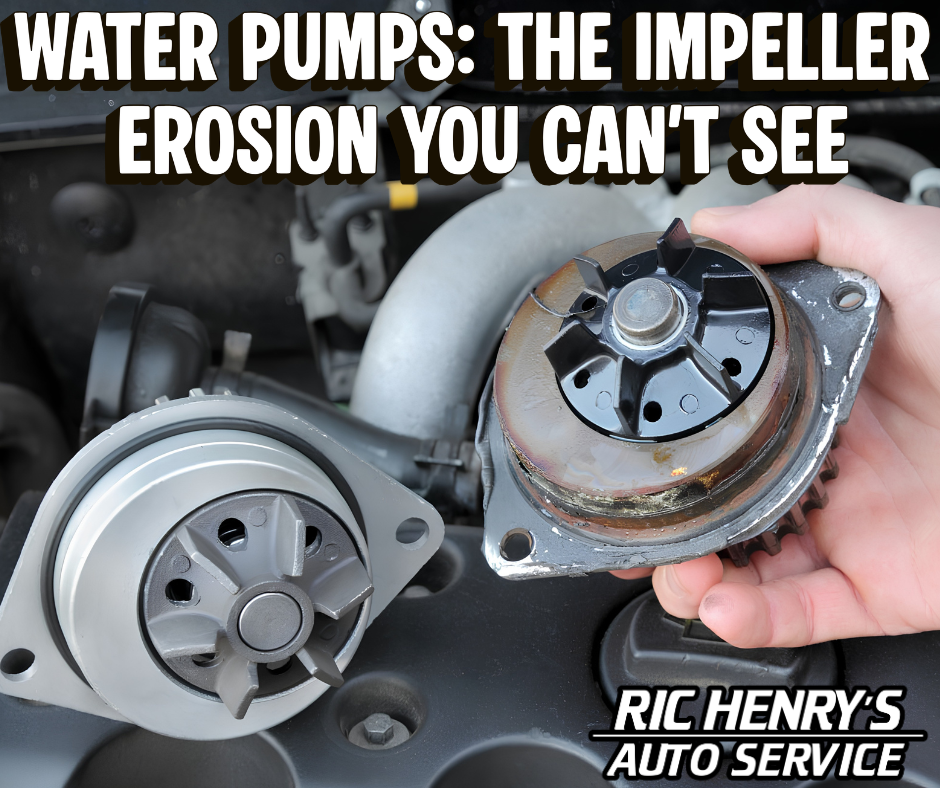
Water pump problems can hide behind impeller erosion and poor coolant circulation. Learn why San Angelo drivers trust Ric Henry's Auto Service for honest diagnostics, modern technology, and dealership-level care.
Is your modern car burning through oil? Discover the causes of excessive oil consumption in new engines and why San Angelo drivers trust Ric Henry's Auto Service, a legacy shop since 1966.

Stop asking, "Why do you need my VIN?" Learn the fascinating history of this 17-digit code, why it is critical for accurate repairs and recalls, and why we insist on it at Ric Henry's Auto Service, San Angelo's trusted dealership alternative since 1966.
Learn what the CAN Bus system does, warning signs of failure, and why San Angelo drivers trust Ric Henry’s Auto Service for honest, dealer-level diagnostics.
Learn what valve float is, its causes and warning signs, and how Ric Henry’s Auto Service provides trusted, modern engine diagnostics and repair for San Angelo drivers.