
The True Cost of Neglecting Your Transmission
NaTasha Brand • September 17, 2025
The Domino Effect: From Slipping to Catastrophe
Let's play a quick game of "Would You Rather?" Would you rather spend $250 on a scheduled transmission service, or $8,000 on a full transmission replacement? It sounds like an easy choice, yet every day, drivers in San Angelo choose the latter by default—through neglect.
Your transmission is the second most complex and expensive component in your vehicle (right behind the engine). It's the unsung hero that seamlessly transfers power from your engine to your wheels, whether you're merging onto the US-87 or cruising through the Concho Valley. But out of sight often means out of mind, and that's a gamble with devastatingly high stakes.
At Ric Henry's Auto Service, we've seen the heartbreak of a neglected transmission one too many times. This post isn't a scare tactic; it's a financial intervention. Let's talk about why transmission fluid is its lifeblood, what happens when you ignore it, and why a professional service is the only smart choice.
Why Transmission Fluid is a Miracle Liquid
Transmission fluid is so much more than just oil. It's a sophisticated hydraulic fluid and lubricant engineered to perform several critical jobs simultaneously:
- Lubrication: It prevents the hundreds of intricate metal parts inside your transmission from grinding themselves into metal dust.
- Cooling: It absorbs and dissipates the immense heat generated by the transmission, especially critical in the San Angelo heat where ambient temperatures can push transmission temps into the danger zone.
- Hydraulic Power: It acts as a hydraulic fluid to engage clutches and bands, enabling your transmission to shift gears smoothly.
- Cleaning: It holds suspended contaminants and worn clutch material in suspension until it can be captured by the filter.
Over time and miles, this fluid breaks down. It loses its lubricating properties, its ability to handle heat, and becomes contaminated with debris. This is why fluid service is not a "maybe" item, it's essential maintenance.
The Special Case of the CVT Transmission
If your vehicle has a Continuously Variable Transmission (CVT), this is even more critical. Unlike traditional automatics with fixed gears, a CVT uses a complex system of pulleys and a steel belt. This design generates even more heat and puts different stresses on the fluid.
CVT fluid is specially formulated for this task. Neglecting a CVT fluid change is a near-guarantee of a premature and catastrophically expensive failure, often with little warning.
The Domino Effect of Neglect: From Slipping to Catastrophe
Ignoring that recommended service interval (usually between 60,000 - 100,000 miles for a traditional automatic, and often sooner for a CVT) starts a costly domino effect:
1. The Fluid Degrades: Old, burnt fluid can't lubricate or cool effectively.
2. Overheating: The transmission runs hotter, which accelerates the fluid's breakdown further, a vicious cycle.
3. Increased Wear & Varnish: Metal parts wear prematurely, and sticky varnish deposits form on valves and solenoids inside the transmission valve body.
4. The Symptoms Appear: You might notice slipping gears (the engine revs but the car doesn't accelerate proportionally), rough or delayed shifting, burning smells, or strange grinding or whining noises.
5. Total Failure: Eventually, the clutches burn up, the bands break, or the transmission seizes entirely. The car may refuse to move at all.
The Sticker Shock: Why a Service Beats a Replacement
This is where the math becomes painfully clear:
- Transmission Fluid Service Cost: $250 - $400 (for a drain, refill, and filter replacement)
- Transmission Rebuild/Replacement Cost: $4,000 - $8,000+
- That "savings" of a few hundred dollars by skipping service just cost you the price of a used car.
Why This is a Job for Professionals, Not DIY
A transmission service is far more involved than an oil change. Here’s why you should always leave it to the pros at Ric Henry's Auto Service:
- Precision Fluid Requirements: Using the wrong type of fluid, even if it says "universal" on the bottle, can destroy a modern transmission. Our technicians use only the specific fluid recommended by your vehicle's manufacturer.
- The Critical "Fill Procedure": Many transmissions require a specific procedure to check the fluid level (often with the transmission at a precise temperature). Too little fluid causes burning and failure; too much can cause foaming and aeriation, which also leads to failure.
- Comprehensive Service: A professional service doesn't just drain and fill. It includes replacing the external filter or cleaning the internal screen and inspecting the system for leaks.
- The Ric Henry's Warranty: When we service your transmission, the job is backed by our 3-year/36,000-mile nationwide warranty. You get peace of mind that the job was done correctly and is protected against defects.
Don't let a simple service interval turn into a financial catastrophe. A transmission is a masterpiece of engineering; it deserves professional care.

Is your car in Limp Mode? Learn why your vehicle limits power to protect the engine and why you should trust Ric Henry's Auto Service in San Angelo for honest diagnostics and dealer-level care.

Unlock the mystery of DEF fluid and Selective Catalytic Reduction. Learn why your diesel drinks it and why Ric Henry's Auto Service is San Angelo's trusted dealership alternative for expert diesel care.
Why does brake fluid need changing in a closed system? Learn how hygroscopy lets water ruin your brakes, and trust Ric Henry's Auto Service in San Angelo for honest, dealership-level care.

Is your car's temperature gauge rising in traffic but dropping on the highway? Learn why this happens and why you should trust Ric Henry's Auto Service in San Angelo for honest cooling system repairs.
Does engine braking damage your car? Discover the truth about downshifting, rev-matching, and brake fade. Trust your vehicle to Ric Henry's Auto Service in San Angelo for expert care.
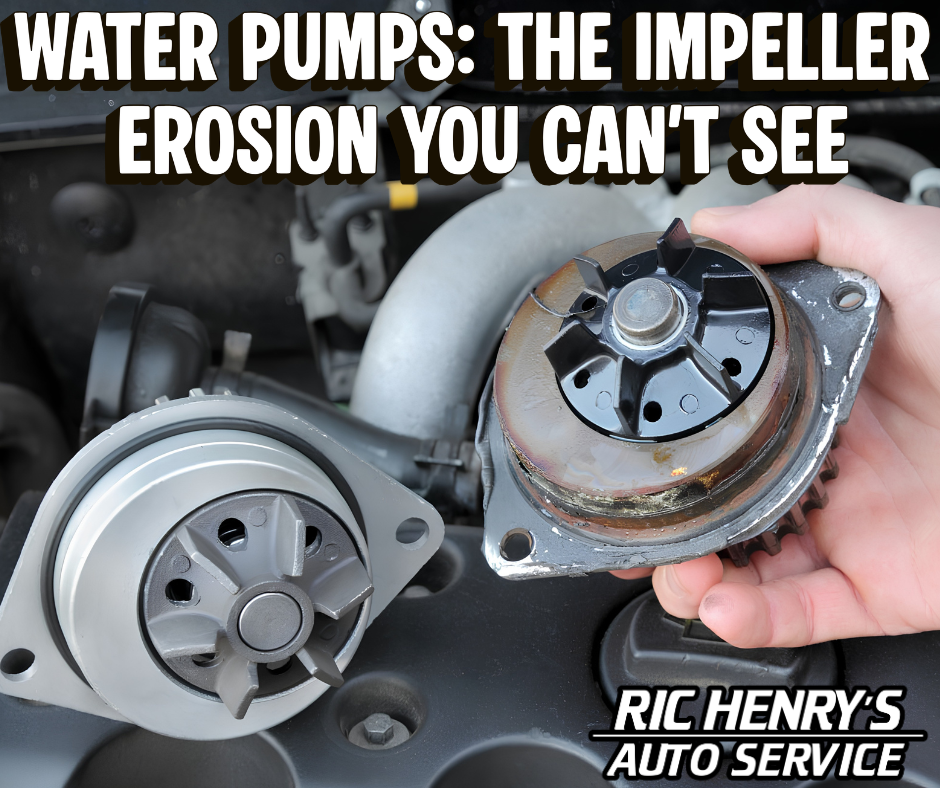
Water pump problems can hide behind impeller erosion and poor coolant circulation. Learn why San Angelo drivers trust Ric Henry's Auto Service for honest diagnostics, modern technology, and dealership-level care.

Is your modern car burning through oil? Discover the causes of excessive oil consumption in new engines and why San Angelo drivers trust Ric Henry's Auto Service, a legacy shop since 1966.

Stop asking, "Why do you need my VIN?" Learn the fascinating history of this 17-digit code, why it is critical for accurate repairs and recalls, and why we insist on it at Ric Henry's Auto Service, San Angelo's trusted dealership alternative since 1966.
Learn what the CAN Bus system does, warning signs of failure, and why San Angelo drivers trust Ric Henry’s Auto Service for honest, dealer-level diagnostics.
Learn what valve float is, its causes and warning signs, and how Ric Henry’s Auto Service provides trusted, modern engine diagnostics and repair for San Angelo drivers.