

Why Does My Phone Charger Work in One Port but Not the Other?"
NaTasha Brand • February 16, 2026
Don't Let a Little Spark Turn Into a Big Headache
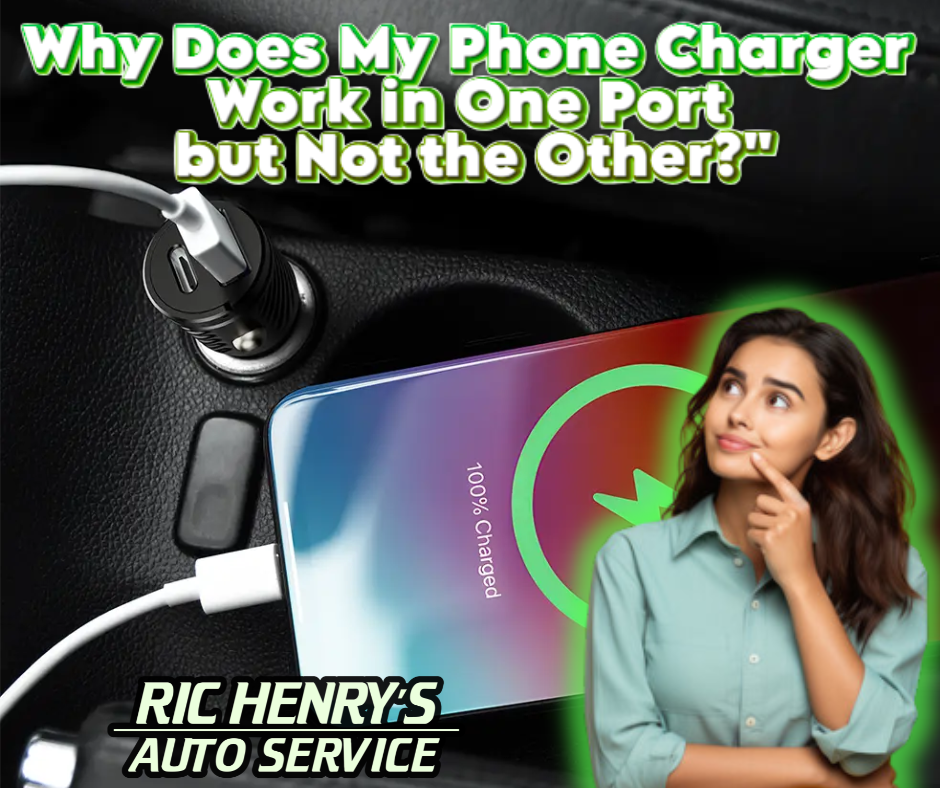
We’ve all been there. You’re cruising down Houston Harte, your battery is hovering around the dreaded 5%, and you desperately plug your phone into the dash to get some juice. Nothing. Zero. Zilch.
So, like any rational person, you jam it into the port by the center console, and suddenly, the little lightning bolt appears. Cue the angels singing.
It’s a mystery as old as cupholders themselves: Why does my phone charger work in one cigarette lighter port but not the other?
Here in San Angelo, where we put serious miles on our trucks and SUVs, this isn't just an annoyance, it's a disruption to your podcast marathon. Before you start fiddling with wires or kicking the dashboard (we’ve all been there, too), let’s pop the hood on this electrical enigma.
The Great Fuse Fiasco
Let’s start with the most likely culprit: the humble fuse. Think of fuses as the unsung heroes of your vehicle’s electrical system. When there’s a power surge or short, they sacrifice themselves to protect your car’s more expensive components.
Your vehicle has multiple 12-volt "cigarette lighter" ports (even if no one has used one to light a cigarette since 2007). Critically, they are usually on different circuits. If you plug in a cheap accessory that pulls too much power, or if the contacts briefly short out, it can blow the fuse for that specific port.
So, when Port A works and Port B doesn’t, it’s highly likely that Port B has a blown fuse. It’s a quick fix, but locating the right fuse in the maze under your dash or hood can feel like a treasure hunt where the treasure is just... getting your phone to work.
Hot, Always Hot, and "I Guess We're Not Hot Anymore"
Not all power ports are created equal. Car manufacturers design them with different personalities.
- Switched Ports (Ignition-Hot): These ports only provide power when the ignition is on or the engine is running. This is a fantastic feature because it prevents you from accidentally draining your battery by leaving a phone charger plugged in overnight. That dead port when your car is off? It’s probably a switched circuit, and it’s actually protecting you from yourself.
- Always-Hot Ports (Constant): These ports draw power directly from the battery at all times. They are perfect for dash cams or devices you need to charge while the car is parked.
If you’re testing your charger with the engine off, you’ve just solved the mystery. The non-working port is likely switched; the working one is always hot.
The Corrosion Situation
West Texas isn't exactly a humidity magnet, but dust and temperature swings can do a number on electrical contacts. Over time, the metal contacts inside the port can corrode or get coated in a film of grime and pocket lint.
If your charger wiggles around like a loose tooth, it might not be making a solid connection with the positive tip or the side grounding tabs. A little cleaning with the right chemicals might bring it back to life, but if the contacts are bent or corroded beyond repair, it’s a job for the pros.
The USB Amperage Conspiracy
If we’re talking about built-in USB ports (the rectangular ones) rather than the round 12-volt sockets, the rules change entirely.
Not all USB ports are built equal. Some are designed for data transfer (like the one for Apple CarPlay or Android Auto) and offer low amperage. Others are designed specifically for high-speed charging.
- USB-A (Old Reliable): These typically output between 2.5 and 7.5 watts. That’s fine for maintaining a battery, but if you’re running GPS and streaming music, your phone might actually lose charge while plugged in.
- USB-C (The Speed Demon): These are the heroes we needed. They can push out upwards of 60 to 240 watts, fast-charging modern phones and even some laptops. If one port charges your phone in 30 minutes and the other takes three hours, you’ve found the difference between a "data" port and a "charging" port.
Don't Let a Little Spark Turn Into a Big Headache
Sometimes, a dead outlet is just a fuse. But sometimes, it’s a symptom of a deeper electrical gremlin. Maybe the wiring behind the dash has chafed, or there’s a short that could lead to bigger problems down the road.
That’s where we come in.
At Ric Henry's Auto Service in San Angelo, we don’t just fix the symptom; we solve the puzzle. We’ve been serving the Concho Valley since the days when Kirksey Auto Service first opened its doors in 1966. Ric took over in 2000, and since then, we’ve been evolving right alongside the automotive industry.
Our shop is constantly investing in the latest diagnostic tools and technology, the same equipment the dealerships use, because we know today’s vehicles are more computer than carriage. Whether you drive a brand-new truck with USB-C fast charging or a classic car with a stubborn 12-volt outlet, our experienced technicians have the training to handle it.
And because we believe in doing the job right the first time, all our services are backed by a 3-year/36,000-mile warranty . You don't get that kind of confidence from just any shop.
So, the next time your phone is on the verge of death and your port is being uncooperative, give us a call. We’ll track down the short, replace the fuse, or diagnose the electrical issue so you can get back to arguing with your friends about the best BBQ in town without that low-battery anxiety.
Trust your car to Ric Henry's Auto Service.

Think differential fluid is "fill for life"? Think again. Learn about heat breakdown, wear metals, and LSD additives. Trust Ric Henry's Auto Service in San Angelo for expert service backed by a 3-year/36,000-mile warranty.

Smell gas after leaving the San Angelo pump? Don’t panic. It might be a stuck purge valve or a flooded charcoal canister. Ric Henry’s Auto Service explains why topping off is a terrible idea and how we fix it right.

Cold start exhaust rattle in San Angelo? It's a heat-shield or flex pipe crying for help! Ric Henry's Auto Service explains why & offers trusted, warrantied repairs. Don't ignore the morning grumble!
Share On: