

What's a Brake Fluid Flush?
NaTasha Brand • March 2, 2026
Can't I just top it off?
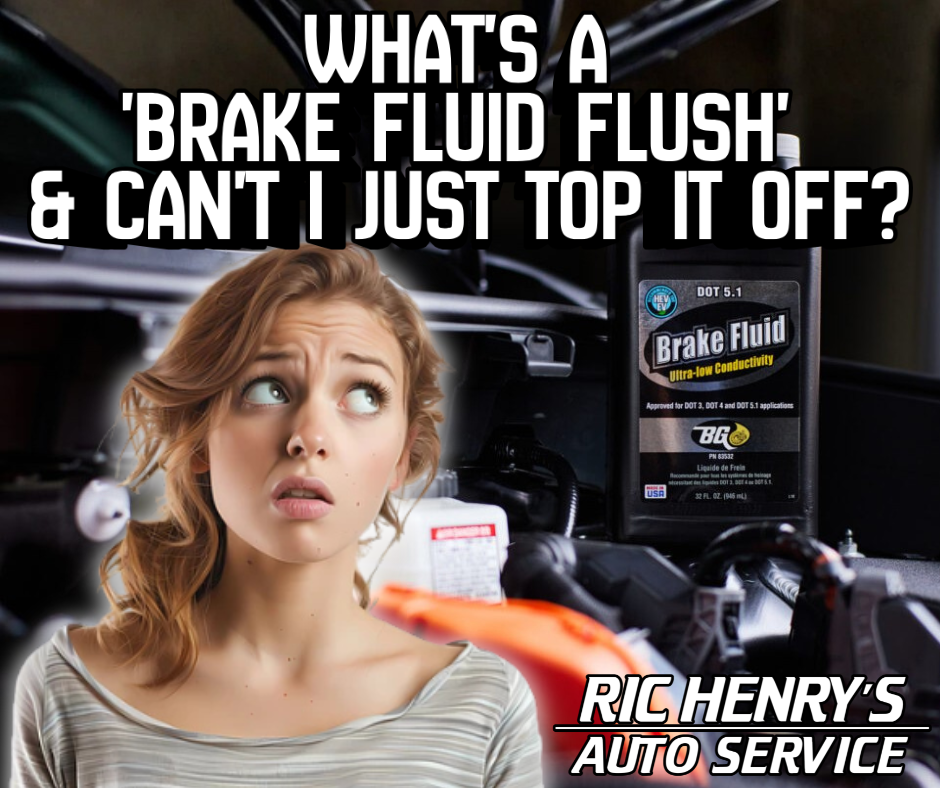
Let’s be honest. When it comes to car maintenance, most of us operate under the "if it ain't broke, don't fix it" mantra. We wait for the shudder, the squeal, or the dreaded glowing orange light on the dashboard before we even think about picking up the phone. And perhaps nowhere is this procrastination more dangerous, and more misunderstood, than with that opaque plastic reservoir under your hood: the brake fluid master cylinder.
I’ve lost count of how many times I’ve heard someone say, "The brake fluid was a little low, so I just topped it off." It sounds responsible, right? You see a problem, you fix it. But here’s the hard truth: topping off your brake fluid is the automotive equivalent of putting a band-aid on a bullet wound. It ignores the real issue, and in the context of your braking system, the real issue is a silent, corrosive, and heat-sensitive gremlin.
To understand why, you have to understand the tragic flaw of the very liquid that stops your two-ton vehicle.
The Thirsty Seduction of Brake Fluid
Brake fluid is fascinating. It’s a hydraulic fluid designed to do one thing: transfer force. When you stomp on the brake pedal, that force travels through the fluid to clamp your brakes shut. It has to withstand massive temperature swings, from freezing cold to the kind of heat that could fry an egg on your calipers.
To do this, brake fluid is engineered with a superpower that is also its kryptonite: it is hygroscopic.
That’s a fancy science term that means it "loves" water. It actually attracts moisture from the air. Now, in a perfect, hermetically sealed world, this would be fine. But your car doesn't live in a lab; it lives in San Angelo, where the humidity fluctuates and the temperature swings are wild. Over time, your brake fluid, via the microscopic pores in rubber hoses and the seals around the reservoir, slowly drinks moisture from the atmosphere.
The Science of "Spongy"
So, what happens when your brake fluid turns into a cocktail of hydraulic fluid and water? Three very bad things.
- The Boiling Point Plummets: Braking creates friction. Friction creates heat, sometimes over 400°F at the calipers. Pure brake fluid is formulated to handle this. But water boils at a measly 212°F. When your fluid is contaminated with as little as 3% water, its boiling point drops dangerously low. When the fluid boils, it creates vapor. Unlike liquid, vapor compresses. So when you push the pedal, instead of clamping the brakes, you’re just compressing air bubbles. That "spongy" or "soft" pedal feel isn't a suggestion; it's a warning that your brakes are fading and about to fail.
- Internal Rust and Corrosion: Water inside your brake lines is like leaving your tools out in the rain. It causes the internal surfaces of your steel brake lines, calipers, and master cylinder to rust from the inside out. This corrosion creates sludge and particles that can damage expensive ABS modules and cause seals to leak. You won't see this rust because it's hidden inside the system, but it’s there, eating away at critical components.
- Component Wear: As the fluid degrades and corrosion sets in, the contaminated fluid acts like sandpaper on the precision internals of your brake system and anti-lock braking system (ABS) modulator, leading to premature failure of expensive parts.
The Flush vs. The Top-Off
This brings us back to the original question: Why can't I just top it off?
Because topping off doesn't remove the waterlogged, corrosive sludge sitting in your calipers. It’s like trying to clean a dirty fish tank by adding a cup of clean water. It doesn't work. You need to evacuate the old, contaminated fluid entirely and replace it with fresh, high-boiling-point fluid.
That’s a Brake Fluid Flush. It’s the only way to reset the clock and ensure that when you need to stop, whether for a deer jumping out on the highway or a red light on Bryant Boulevard, your vehicle responds with instantaneous, predictable force.
Who to Trust With Your Life (and Your Car)
Now, you could watch a YouTube video, buy a buddy a six-pack, and try to bleed your own brakes. It’s messy, it’s toxic, and if you get it wrong (or let the reservoir run dry), you introduce more air into the system, making things exponentially worse.
This is where you need a shop you can trust. A shop that has been evolving with the industry, not just resting on its laurels.
In San Angelo, that shop is Ric Henry's Auto Service. Since 1992, they haven't just been fixing cars; they've been studying them. Owner Ric Henry is known for constantly purchasing the latest tools and technology and attending classes to stay current on all makes and models. In fact, their reputation is so solid that other local shops, and even dealerships, have been known to send their own problem vehicles to Ric Henry when they can't figure out the diagnosis.
That’s the level of expertise we’re talking about.
When you bring your car to Ric Henry’s for a brake fluid flush, you aren't getting some rookie with a wrench. You're getting experienced technicians who use the same tools and diagnostic equipment the dealerships use. Whether it’s a minor fix, a major overhaul, or just routine system maintenance, we treat your vehicle with the respect it deserves.
And because we stand behind their work, every service weprovide is backed by an industry-leading 3-year/36,000-mile warranty. You don’t get peace of mind much better than that.
So, the next time you look under the hood and notice that brake fluid is a little low, don’t just top it off. Don’t ignore it. Bring it to the experts at Ric Henry’s Auto Service on Washington Drive.
Because in a city where we look out for our neighbors, we also make sure they can stop to say hello.
Hear a loud pop from under the hood? Our latest blog post dives into the causes, from lean mixtures to timing issues.
Is your car playing games with you? Power locks working when they want? Our latest blog post from Ric Henry's Auto Service in San Angelo explains the common causes of intermittent lock problems and why expert diagnosis is key. Read more!
Experiencing grabby or touchy brakes in San Angelo? Discover why it happens from glazed pads to contaminated friction material. Trust Ric Henry's Auto Service for expert diagnosis and repair.
Share On: