Turbo vs Supercharger: What's the Real Difference?
And what do they do?
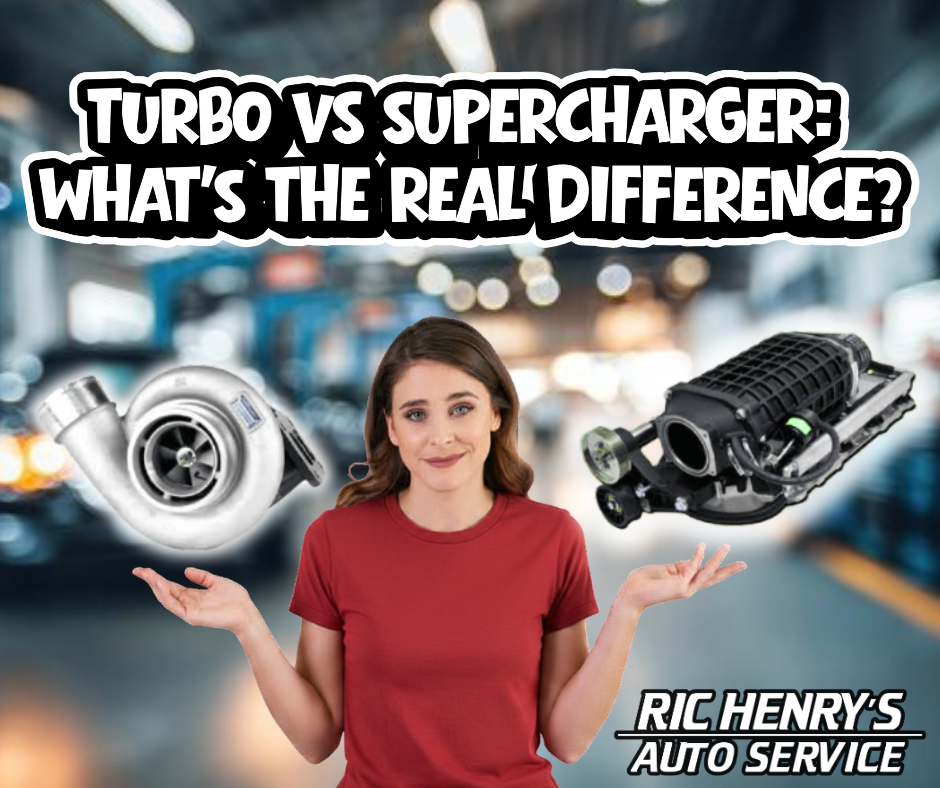
Let's settle an age-old debate. The one that gets car guys revved up more than a fresh set of tires on a Texas backroad. We're talking about the battle of forced induction: Turbocharger versus Supercharger. We get asked about this all the time here in San Angelo, so we figured it was time we laid it all out on the table for you in a way that makes sense.
At Ric Henry's Auto Service, our family auto repair roots date back to 1966. We've been proudly serving San Angelo drivers for generations. Cars aren't just our industry; they are our passion. And trust us, we've seen every type of power adder under the sun.
So, what is the big difference? Both are trying to achieve the same goal. They want to force more air into your engine to create more power. An engine is basically an air pump. The more air you pump in, the more fuel you can burn, and the bigger the bang. That bigger bang is what you feel when you mash the gas pedal.
What is a Turbocharger and Where Is It Located?
Think of a turbocharger as the recycler of the engine world. It uses the energy from your engine's exhaust gases to spin a turbine. That turbine is connected to a compressor that sucks in fresh air and crams it into your engine. It's like catching the wind from a fan and using it to power a bigger fan.
In most cars, the turbo is bolted right to the exhaust manifold or very close to it. Because it relies on hot exhaust gas to spin, it needs to be in the direct path of that heat. Since it isn't mechanically connected to the engine like a belt-driven accessory, it gets its power from exhaust flow. This is why turbochargers are often tucked away in the engine bay, sometimes making them a bit harder to spot. They are also very common on modern diesel trucks you see driving around San Angelo.
What Does a Turbocharger Do?
A turbo uses what would otherwise be wasted heat and pressure from your exhaust to create boost. Because it relies on exhaust gas to "spool up," there's often a slight delay between hitting the throttle and feeling the power surge. This is the famous "turbo lag." However, modern turbos are incredibly efficient. They can add up to 150 horsepower or more, and they are generally better on fuel economy than their supercharged cousins because they aren't robbing power from the engine to run.
What is a Supercharger and Where Is It Located?
Now, a supercharger is more like a direct employee. Instead of waiting for exhaust gas to spin it up, a supercharger is driven directly by a belt that connects to your engine's crankshaft. It's always working, which means no lag and instant power the moment you press the pedal.
You'll almost always find a supercharger sitting right on top of the engine, looking like a big metal beast with a pulley system attached. That prominent placement isn't just for show. It needs to be connected to that belt drive, so it lives right up top where everyone can see it. This setup also makes them easier to spot when you pop the hood at a car show or a meetup here in West Texas.
What Does a Supercharger Do?
A supercharger provides immediate, linear power. When you hit that gas, you get that neck-snapping response without waiting for anything to "spool." The trade-off? Because it's driven by the engine itself, it uses engine power to make engine power. There's a parasitic loss, meaning some of your engine's energy is used just to spin that supercharger. They are less fuel-efficient than turbos, but for pure, instant gratification, they are hard to beat.
The Real Differences Between Them
Let's break this down the way we do when a customer rolls in with questions.
Power Delivery: A turbocharger builds power gradually and peaks at higher RPMs. A supercharger gives you that immediate, low-end punch that pins you to your seat from a dead stop.
Efficiency: Turbos win this round. They use waste energy, making them more fuel-friendly for daily driving. Superchargers are always spinning, always consuming energy, which means more trips to the gas station here in San Angelo.
Heat Management: Turbos generate a lot of heat because they are exhaust-driven. That heat needs to be managed carefully to avoid engine damage. Superchargers run cooler by comparison, but they still generate their fair share of friction heat.
Maintenance: This is where it gets real for us. Turbos have complex oil lines and cooling systems that need to be maintained. Skip an oil change, and you could cook that turbo faster than a jalapeno on a July afternoon. Superchargers are simpler mechanically but have their own belt and bearing systems that require attention.
Sound: Let's be honest, this matters. A turbo gives you that distinctive whistle and whoosh when you let off the gas. A supercharger gives you that deep, mechanical whine that sounds like a wild animal under your hood. Both are music to our ears.
Which One Is Better?
That is the million-dollar question. And the answer is: it depends on what you want out of your vehicle.
If you are looking for maximum fuel efficiency with the potential for big power on the highway, a turbo is your friend. If you want that seat-of-your-pants, instant throttle response and that iconic whine, you want a supercharger. Both can make big power, but they do it very differently.
Why You Need a Shop You Can Trust
Now that we have the technical stuff out of the way, let us talk about something equally important: who is going to work on this beast of an engine you are building? Whether you are driving a turbocharged diesel through the streets of San Angelo or a supercharged muscle car out on the open road, these systems are complex. They run on the edge of what is mechanically possible, and one wrong move can turn your pride and joy into an expensive paperweight.
This is why you need to trust your car to a shop that has been evolving with the industry. We are not the same shop we were in 1966, and that is a good thing. While our roots go deep, we have kept up with every technological leap the automotive world has thrown at us. We are a fully modernized shop with all the latest tools and tech to take care of San Angelo drivers.
When you bring your vehicle to us at Ric Henry's Auto Service, you are getting dealer-level care without rearranging your life. We use the same tools and equipment that the dealership uses. Our experienced technicians are equipped to handle a wide range of repairs, from minor fixes to major overhauls. We also offer multiple other system maintenance services to keep your vehicle running like new.
We explain the repair before we sell the repair. No surprises, no hidden fees, just honest diagnostics from San Angelo's trusted dealership alternative. And we back our work with a 3-year, 36,000-mile warranty on all services we provide. That is peace of mind that you simply will not find just anywhere.
We also make the process as painless as possible. We offer concierge pickup, early-bird drop-off, online booking, and phone status updates. We know you have a life, and we do not want to disrupt it. Cars are more than our industry, it is our passion, and we take big Texas pride in being who San Angelo can trust for generations.
So whether you are boosting your daily driver or just trying to keep your naturally aspirated engine running strong, remember that forced induction or not, your car deserves the best care possible. And you deserve the peace of mind that comes from working with a shop that treats your vehicle like it is our own.
At the end of the day, the difference between a turbo and a supercharger is fascinating. But the difference between a good shop and a bad one is what keeps you on the road and out of the repair bay.
Choose wisely, San Angelo. We have been here since 1966, and we are not going anywhere.