
My CV Axle is Clicking, Can Repairs Wait?
NaTasha Brand • April 13, 2026
(short answer: NO)
You hear it when you pull into the H-E-B parking lot. A rhythmic clicking. Maybe it gets louder when you turn right. Maybe it clicks four or five times as you straighten the wheel. You turn up the radio. The click wins. Now you are wondering: how long before this thing leaves me stranded on Houston Harte?
We are Ric Henry’s Auto Service, and we have answered that question more times than we can count. The short answer is frustrating. Your clicking CV axle could last two weeks or two months. But here is the truth you need to hear. Every single click is a tiny hammer striking the inside of your joint. And hammers always win eventually.
The Life Story of a Dying CV Axle
Your CV axle, constant velocity axle, is a brilliant piece of engineering. It transfers power from your transmission to your wheels while allowing the suspension to move up and down and the wheels to turn left and right. Inside that joint are steel balls riding in precision ground races. Everything is packed with high moly grease and sealed by a rubber boot.
That boot is the gatekeeper. When the boot tears, and they all tear eventually on Texas roads, three bad things happen very quickly.
First, grease flings out. That grease is not optional. It reduces friction and carries heat away from the balls and races.
Second, dirt and grit from San Angelo streets find their way inside. West Texas dust is essentially fine sandpaper. It grinds the hardened steel surfaces like a slow-motion cutting tool.
Third, moisture follows. Once the grease is gone and dirt is in, rust starts forming on the bearing surfaces. Rust flakes off and becomes more abrasive material. It is a death spiral.
Clicking Means the Joint Is Already Damaged
Here is the part most drivers get wrong. A clicking CV joint is not an early warning. It is a late-stage alert. The damage has already happened. The steel balls have worn flat spots. The races have developed pitting. The grease is either contaminated or completely absent.
That clicking sound you hear is a steel ball skipping over a damaged race instead of rolling smoothly.
Every click wears the components further. Clearance increases. The joint becomes looser. Eventually the balls can shift far enough that the joint binds or separates entirely.
We have seen axles click for six months without failing. We have also seen a customer drive into our shop on Knickerbocker Road with a perfectly silent axle, then fail to leave because the joint came apart while backing out of a parking space. There is no reliable countdown timer. There is only probability, and it gets worse every mile.
How Long Before Complete Failure? Weeks or Months, But Always Stranded
The honest range is anywhere from 500 to 5,000 miles of driving after the clicking starts. But that range means nothing when you are the one sitting on the shoulder of Loop 306 waiting for a tow truck.
When a CV joint fails completely, one of two things happens. On most front wheel drive cars, the inner joint separates first. The axle spins freely inside the torn housing. Power no longer reaches that wheel. Your car moves maybe 50 feet before you realize you are going nowhere. On some vehicles, the outer joint fails catastrophically. The axle shaft can flail around and damage your brake line, speed sensor, or even puncture the transmission case.
Either way, you are stranded. A $300 axle replacement becomes a $500 tow plus an axle plus whatever else got broken in the process.
The Professional Fix: Replace the Axle When Clicking Starts
We do not rebuild CV axles at Ric Henry’s Auto Service. The labor cost to clean, inspect, regrease, and reboot a joint exceeds the price of a brand-new axle with fresh grease, new boots, and new hardware. We replace the axle as a complete unit. The job involves removing the wheel, disconnecting the lower ball joint, pulling the axle from the hub and transmission, then installing the new unit. For most front wheel drive cars, we are done in about an hour per side.
We also inspect the other side while we are there. CV boots on the same axle tend to fail within similar timeframes. If one boot is torn, the other side often shows cracking or hardening. Replacing both axles at once saves you a second alignment and second labor charge six months from now.
Why You Need a Shop You Can Trust, One That Has Evolved with the Industry
You could buy a cheap axle online and wrestle it in your driveway. We understand the appeal. But we have fixed too many DIY axle jobs that went wrong. Axles that were not fully seated and leaked transmission fluid. Axle nuts torqued incorrectly leading to wheel bearing failure. Ball joint bolts left loose. The list is long.
You should trust your car in the hands of Ric Henry’s Auto Service. We have been evolving with the automotive industry for years. Modern vehicles use complex axle designs with ABS tone rings, vibration dampers, and specific heat treat requirements. We source quality axles that meet or exceed OEM specifications, not the cheapest metal from an internet warehouse.
We offer comprehensive auto repair services in the San Angelo, Texas area. Our experienced technicians are equipped to handle a wide range of repairs, from minor fixes to major overhauls. We use the same tools and equipment that the dealership does. We also offer multiple other system maintenance services including alignments, brake service, suspension repair, and transmission fluid exchanges. Every service we provide carries a 3 year/36,000 mile warranty. That warranty is our way of saying we stand behind every bolt we turn.
That clicking axle is not going to heal itself. It is not going to get quieter. And it is definitely not going to wait for a convenient time to fail. Trust us on that. We have seen a CV joint let go in a Dairy Queen drive thru. The customer was holding a Blizzard when the car stopped moving. The Blizzard did not survive the tow truck ride.
Is your car clicking when you turn, or are you still pretending it is just a rock in the tire tread?
Give us a call at Ric Henry’s Auto Service before that pretend game leaves you walking.

Does Eco Mode actually save you money? Ric Henry's Auto Service in San Angelo breaks down throttle mapping, shift points, and AC cycling to give you the honest answer. Trusted auto repair since 1966.
Is running your car low on gas bad? We debunk the fuel pump cooling myth and the sediment reality. Trust Ric Henry's Auto Service in San Angelo for honest diagnostics.
Is your clutch slipping or smelling like burnt money? Learn the signs of clutch failure and why San Angelo trusts Ric Henry's Auto Service for honest diagnostics and dealer-level care.

Wondering why your European car has such frequent service intervals? Ric Henry's Auto Service in San Angelo explains the engineering behind the schedule and why trusting a modern, experienced shop matters.

Carbon cleaning is not optional on direct-injection European cars.

Is your car in Limp Mode? Learn why your vehicle limits power to protect the engine and why you should trust Ric Henry's Auto Service in San Angelo for honest diagnostics and dealer-level care.
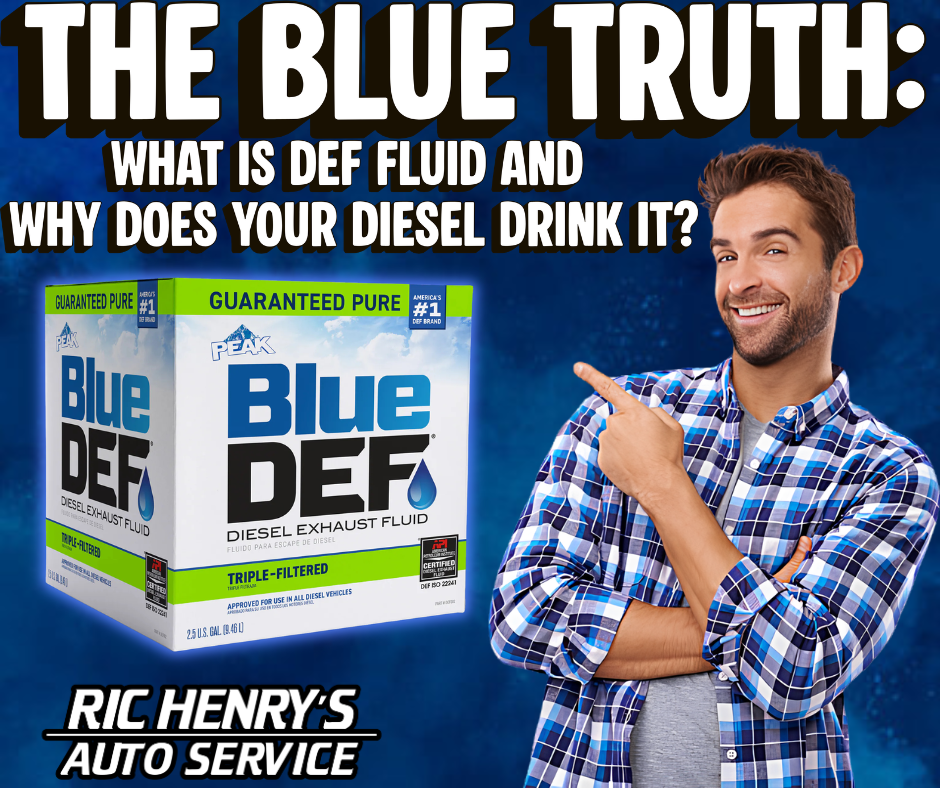
Unlock the mystery of DEF fluid and Selective Catalytic Reduction. Learn why your diesel drinks it and why Ric Henry's Auto Service is San Angelo's trusted dealership alternative for expert diesel care.
Why does brake fluid need changing in a closed system? Learn how hygroscopy lets water ruin your brakes, and trust Ric Henry's Auto Service in San Angelo for honest, dealership-level care.

Is your car's temperature gauge rising in traffic but dropping on the highway? Learn why this happens and why you should trust Ric Henry's Auto Service in San Angelo for honest cooling system repairs.
Does engine braking damage your car? Discover the truth about downshifting, rev-matching, and brake fade. Trust your vehicle to Ric Henry's Auto Service in San Angelo for expert care.